— by Hana Girma Mamo —
Instrumentalization of migration is a deliberate act of using irregular migrants as an instrument to achieve political, economic, and military objectives. This act is deliberately conducted by governments and entities to encourage the movement of people toward a targeted country and to put pressure on its immigration and asylum system. The instrumentalization of migration is not something that came into existence in recent years but its usage can be traced back to the Cold War era. In 1980 due to the economic hardship in Cuba, most Cuban people were dissatisfied with the Fidel Castro government. In April 1980 Fidel Castro announced that anyone who wanted to leave the country could leave using the port of Mariel located near Havana. He intended to allow undesirable individuals like criminals, mentally ill persons, and political dissidents to leave the country. The sudden arrival of 125,000 Cubans to the US destabilized the US migration system. The US government was highly criticized for the way it handled the crisis. In addition to this while sending the migrants from Cuba the Cuban government included individuals who had a criminal record and it was estimated that about 15,000-20,000 migrants had a criminal record. This in turn created anti-immigrant sentiment in the US community. This event in history is known as “The Mariel Boatlift”. It was also used by Turkey during the Syrian civil war in 2011 where Turkey threatened the EU saying it would open its border unless Turkey got economic support from the EU to handle the refugees. Due to this, the EU pledged €6 billion in financial aid to Turkey to support its refugee population. From the above historical events we can understand that different countries use instrumentalization of migration for different purposes. Belarus began instrumentalization of migration in mid-2021 because the EU sanctioned the country due to the 2020 disputed presidential election and subsequent crackdown on protest. The government of Belarus targeted Poland, Lithuania, and Latvia to destabilize the EU as retaliation to the sanction imposed by the EU. Poland as a response to the crisis militarized its border, declared a state of emergency in the border region, and was also accused of an act of push-backs of immigrants which directly violates the non-refoulement principle of international law. This short article tries to examine the political motive of Belarus and tries to discuss the resulting human rights violation of migrants.
The Geopolitical Dynamics of Migration as a Tool
In July 2021 European Commission President Ursula von der Leyen accused the Belarus government of issuing tourist visas to migrants who had no intention of staying in Belarus to destabilize the EU. President Alexander Lukashenko, the leader of Belarus, denied the EU’s accusations, claiming that Belarus was not facilitating illegal migration but instead honoring its obligations under international agreements. He stated that Belarus had a right to issue visas to anyone who wished to visit the country. In one of his responses, Lukashenko explicitly rejected the notion that Belarus was orchestrating the movement of migrants into the EU, stating, “We do not want any tensions” but warned that Belarus would not prevent migrants from moving westward if they arrived in Belarus. He also famously threatened that if the EU continued with sanctions, Belarus would stop “holding back” migrants from entering the EU. This was seen as a clear attempt to use the migrant flow as leverage in the broader geopolitical struggle between Belarus and the West. On 1 December 2021, an Amnesty International press release also condemned Lukashenka’s mistreatment and instrumentalization of migrants and accused him of using those asylum seekers as a threat. On 9 November 2021, the UNHCR and IOM press release announced that they repeatedly communicated to the Belarusian authorities not to create a difficult humanitarian crisis for the purpose of achieving a political end. On 26, November 2021 BBC News reported that some immigrants who arrived at the Poland border confessed how the Belarusian soldiers helped them at night by cutting wires so that they could easily cross the border. In addition to this, it’s important to see how the Belarus government was facilitating the arrival of those immigrants. Most of the immigrants came from Afghanistan, Iran, Iraq, and Syria to Belarus. This is because recently Belarus introduced simplified visa rules and the Belavia Airline of Belarus reported to have a higher flight to Turkey. This made Belarus an easy route to reach EU countries and with no restriction from the Belarus government, they can easily cross the borders. Belarusian travel agencies also advertised Belarus as an easy route to Europe in the Middle East countries. In addition to this Belarus authorities are also accused of facilitating the transportation of immigrants closer to borders. With all fingers pointed at Belarus the next question we should ask ourselves is what could possibly Belarus gain from doing this? First Belarus used this tactic as retaliation to the sanction imposed by the EU. By doing so they tried to cause disruption at the EU’s borders, forcing Europe to deal with a humanitarian and political crisis. Lukashenko famously said, “We stopped drugs and migrants. Now you will eat them and catch them yourselves.” This signaled Belarus’s willingness to weaponize migration as a response to Western pressures. Secondly, migration has and is always been a debatable issue in Europe with countries having different standpoints on the issue. By instrumentalizing migrants and escalating the situation, Belarus hoped to create rifts between EU nations on how to handle the migrant crisis, particularly between Eastern and Western European countries. Finally, by claiming to stand strong against Western pressure (and using migration to do so), Lukashenko sought to solidify his authority domestically and show that Belarus was independent and unwilling to bow to the EU which would increase the domestic support for the Lukashenko regime.
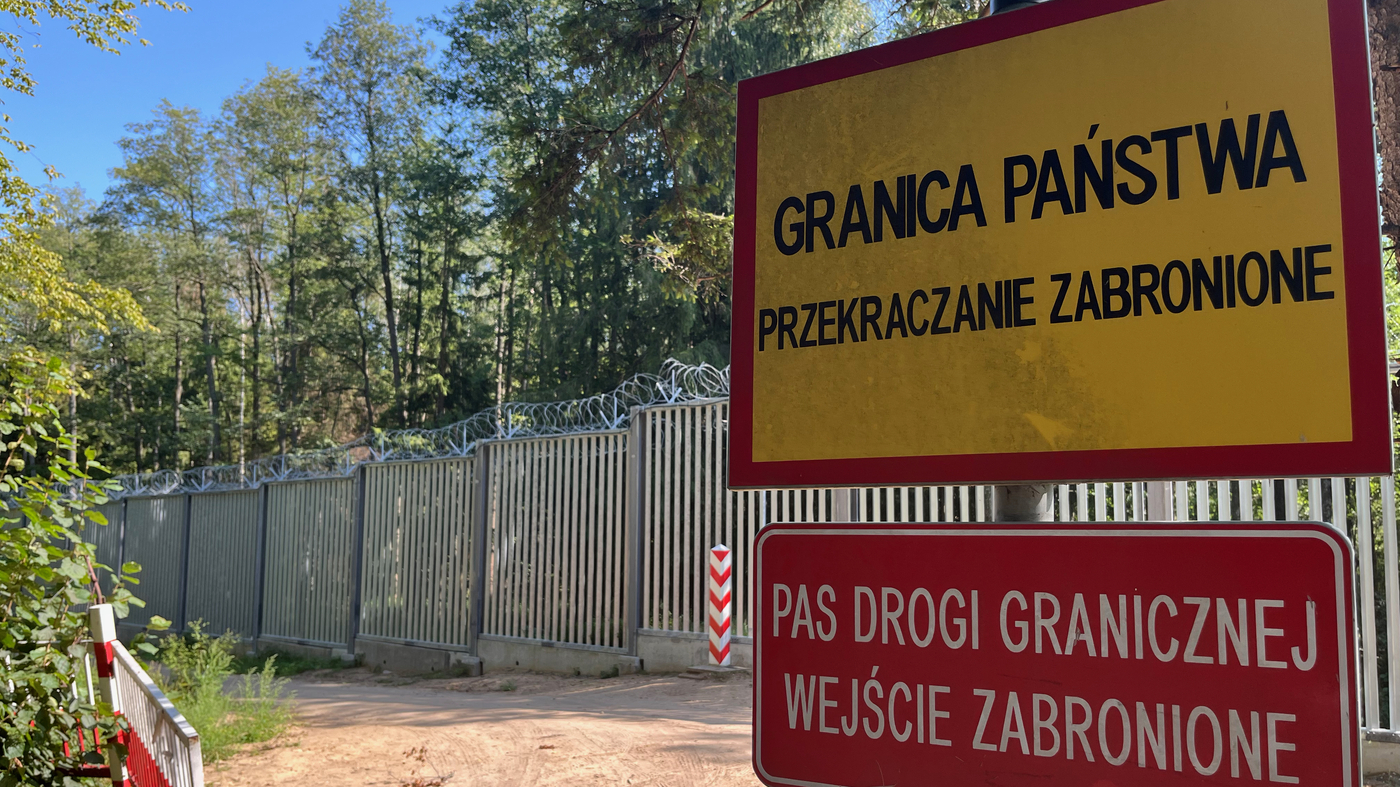
In response to the Belarusian government act, the Polish government strictly militarized its border to restrict the crossing of illegal migrants. This was done by putting a lot of soldiers on the border and in early 2022 the construction of border walls began. The Polish authorities set a timeline for completing the project by mid-2022. They allocated approximately €353 million for the wall’s construction. The wall is approximately 5.5 meters (18 feet) high and stretches about 186 kilometers (116 miles) along the border. It features high-tech surveillance systems, including motion sensors, cameras, and infrared sensors, to monitor migration attempts and enhance border security. In addition to this, the Polish government also gave some access to international organizations like UNHCR to help the immigrants who are on the side of Belarus territory but at the same time it has been accused of push backs of immigrants which explicitly contradicts the non-refoulement principle of international law.
Belarus instrumentalizing migrants and the response of Poland to the 2021-2022 migration crisis has broader implications both regionally and globally and I choose to discuss some of them as follows:-
- Impact on border security and control: Poland’s action set a precedent on how the EU will handle the migration crisis in the future. Poland’s border wall and security measures challenged the EU’s open-border policies while also raising concerns about the humanitarian impact on migrants.
- Humanitarian consequence and international law: Poland’s approach to dealing with the migration crisis, especially through pushback forcing migrants back into Belarus has led to serious humanitarian concerns. International organizations like Amnesty International and the UDHR have condemned the actions, stating that such practice violates international refugee laws, particularly the right to seek asylum and the non-refoulement principle, which prohibits the return of migrants to places where they may face danger or prosecution.
- Impact on EU cohesion and migration policies: The crisis exposed deep divisions within the EU on migration policy. Eastern European countries like Poland and Hungary often adopt hard-line stances on migration, prioritizing border security and sovereignty over humanitarian concerns. On the other hand, Western European countries such as Germany, France, and Belgium were more likely to emphasize human rights and the need for solidarity in handling migrants. These policy differences between EU member states have made it difficult to develop a cohesive EU migration policy, with Eastern countries resisting efforts to redistribute migrants across EU countries
The Human Rights Cost of the Belarus-Poland Border Crisis
The 2021-2022 border crisis between Belarus and Poland sets a dangerous precedent for future border crises where migrants and asylum seekers are treated as political pawns rather than individuals with rights. If EU member states adopt more restrictive measures to control migration, it could lead to the erosion of asylum systems and the undermining of international refugee laws. The construction of the Polish border wall and the deployment of military forces at the border have made it clear that militarized border controls may become more widespread in Europe. This trend could result in increaseduse of force at borders, military policing, and barrier construction to deter migrants, further restricting freedom of movement. Furthermore, the EU’s failure to fully address the humanitarian crisis and protect the rights of migrants may affect its international reputation as a defender of human rights. Global actors watched how the EU handled such crises, which could influence the EU’s role in global human rights advocacy and its diplomatic relations with countries facing migration pressures. In the future to avoid such failures the international community must reinforce existing legal mechanisms, such as the 1951 Refugee Convention and the Universal Declaration of Human Rights, to ensure that states uphold their obligations even in politically charged situations. Clear legal consequences for states that engage in the instrumentalization of migration should be established, alongside mechanisms for monitoring compliance. Governments and officials who orchestrate or enable the instrumentalization of migrants must face legal accountability through international tribunals or domestic courts. Establishing clear precedents for such cases would deter future misuse of migration as a geopolitical tool. By adopting these measures, the international community can not only protect the rights of migrants but also dissuade governments from exploiting vulnerable populations for political gain. Safeguarding human dignity and upholding international law should remain at the core of every response to migration crises, ensuring that humanity prevails over politics.
Sources:
- BBC News, ‘Belarus migrants: EU accuses Lukashenko of gangster-style abuse‘, BBC News, 9 November 2021, https://www.bbc.com/news/world-europe-59215769
- Politico, ‘Lukashenko warns EU that Belarus won’t stop migrant border surge‘, Politico, 6 July 2021, https://www.politico.eu/article/belarusian-president-alexander-lukashenko-warns-eu-belarus-wont-stop-migrant-border-surge-lithuania
- Associated Press, ‘Poland completes Belarus border wall to keep migrants out‘, AP News, 30 June 2022, https://apnews.com/article/russia-ukraine-africa-poland-forests-middle-east-443c8068ea7b5d1d8f6980da6e3879af
- VOA News, ‘Belarus threatens to “flood” Europe with migrants and drugs in response to sanctions‘, VOA News, 26 May 2021, https://www.voanews.com/a/europe_belarus-threatens-west-eu-debates-severe-sanctions/6206322.html
- Hybrid CoE, ‘Instrumentalized migration and Belarus‘, Hybrid Centre of Excellence, 25 April 2023, https://www.hybridcoe.fi/wp-content/uploads/2023/04/20230425-Hybrid-CoE-Paper-17-Instrumentalized-migration-and-Belarus-WEB.pdf
- Amnesty International, ‘Belarus/EU: New evidence of brutal violence from Belarusian forces against asylum seekers and migrants facing pushbacks from the EU‘, Amnesty International, 20 December 2021, https://www.amnesty.org/en/latest/news/2021/12/belarus-eu-new-evidence-of-brutal-violence-from-belarusian-forces-against-asylum-seekers-and-migrants-facing-pushbacks-from-the-eu/
- UNHCR, ‘UNHCR and IOM call for immediate de-escalation at the Belarus-Poland border‘, UNHCR News, 10 November 2021, https://www.unhcr.org/news/news-releases/unhcr-and-iom-call-immediate-de-escalation-belarus-poland-border
- UNHCR, ‘UNHCR and IOM shocked and dismayed by deaths near Belarus-Poland border‘, UNHCR News, 19 November 2021, https://www.unhcr.org/news/news-releases/unhcr-and-iom-shocked-and-dismayed-deaths-near-belarus-poland-border