— by Joelle Alkontar —
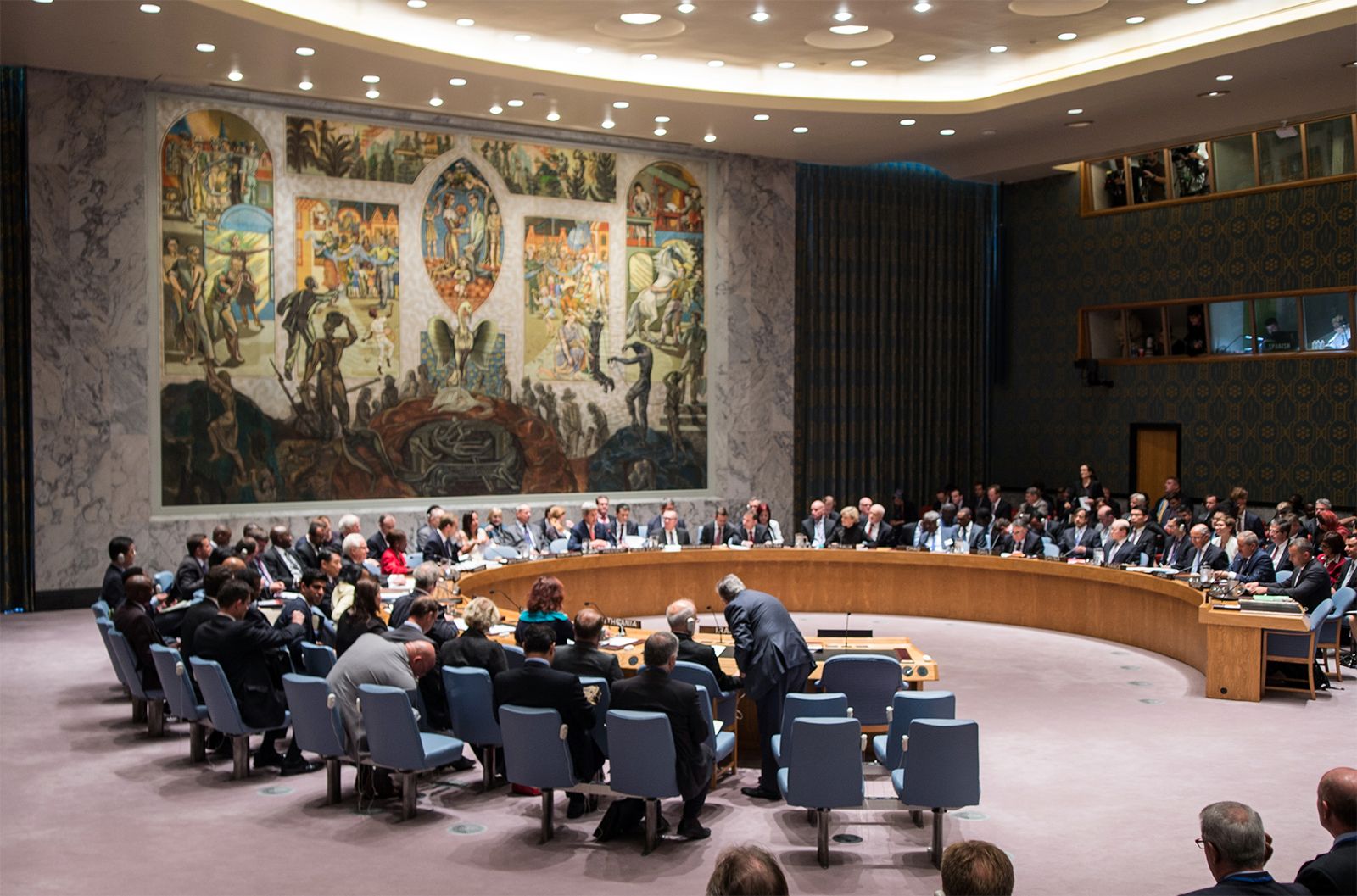
“There is no time as the present, where the reform of the Security Council has been necessary and urgent,” said South Africa’s delegate to the United Nations in November 2024 in response to the Russian Federation’s recent vetoing of Security Council resolution on the dire Sudanese conflict, regretting that “from Africa to the Middle East, the world is in turmoil because the tools in the hands of the United Nations have been blunted by the use of the veto.” Today, Sudan, Ukraine, Yemen, and the Palestinian territories are just a few of the areas where peace has not yet been achieved and human suffering has become a part of daily life. The system and structure of the UN Security Council have often been used to prevent any real action towards resolving conflicts all around the world, primarily due to the interests of the world’s major powers, particularly the five permanent members: The United States, China, Russia, Britain, and France. The necessity of a Security Council reform is not a recent suggestion and has in fact been discussed for decades and has been a constant topic of debate in the UN General Assembly since the early post-Cold War period. In 2004, former UN Secretary-General Kofi Annan said that “the Security Council needs credibility, legitimacy and better representation to do everything we ask of it.” The current war between Ukraine and Russia, which has demonstrated the impotence of the UN when one of its own permanent members endangers the UN’s core essence and violates another state’s sovereignty, has brought renewed energy to the debate on Council reform. In this article, I will cover briefly the necessity for this reform and how it might look in practice.
Perhaps the most important fact to note is that the geopolitical realities within the global sphere have changed remarkably since the creation of the United Nations and the composition of the Security Council has not kept pace with these changes. To better reflect these geopolitical realities of the contemporary world order, many experts argue that increasing permanent membership will enhance the Council’s effectiveness, and this in turn would enhance the legitimacy of the body. Additionally, the veto power, which is considered a privilege of major powers, has drawn criticism from the general membership throughout the UN. The Council’s historical inability to play an effective role against Israel’s controversial actions in Palestine (due to the US and its veto) and its failure to effectively intervene in Syria (due to the Russian and Chinese vetoes) are prime examples of how this veto power has often hindered the UN’s effectiveness in conflict resolution, leading to the widespread belief that the council’s actions and efficiency will always be dictated by the national interests of these major powers, who will ultimately shape the reality of the world. Moreover, if there is one vital thing that deserves reform in the Security Council, it is the veto system of the five permanent members. The system is a legacy of the post-World War II world where the veto system was initially introduced as an attempt to maintain peace and stability by the victors of the war. Then, the Cold War brought in two superpowers, both of whom were permanent members of the UN Security Council, and the veto system was able to balance the power and influence of the two nation-states in the UN. The United States emerged as the winner of the Cold War and the superpower that defeated the Soviet Union. Since then, the world has been evolving rapidly and new economic powers such as Japan and India have emerged in a multipolar system, proving themselves as real challengers to the United States’ position as the world’s sole superpower. Furthermore, the effectiveness, credibility, and legitimacy of the Council’s work undoubtedly revolve around its representative character. “For the UN to be legitimate, it must be ‘democratic’, i.e. representative of all states,” says Dr. Jerzy Kochanski, a Polish expert on international relations and the UN in particular. Thus, reform that addresses today’s political realities and increases representation will help improve the Council’s legitimacy.
Beneath the veto reform controversy lies critical geopolitical and regional rivalries. China, Russia, and the United States have all supported greater global representation for the South, but they are known to oppose the expansion of both permanent memberships in the council and any change to the veto system. In addition to power politics, the emerging powers that many see as candidates for permanent seats on a reformed Council have their own powerful regional rivals. Neither Argentina nor Mexico are interested in establishing Brazil as a Latin American power, China’s stance on Japan is ambivalent at best, and Pakistan is keen to prevent the rise of India. In Europe, Spain and Italy share concerns about structural changes favoring individual countries like Germany, and the four most powerful African states; Algeria, Nigeria, South Africa, and Egypt have fought internally to maintain their positions as favorites for permanent African seats. When it comes to the United States, during a plenary session of the 2020 UN General Assembly, for example, a US official representing the Trump administration said that “the United States was in favor of a modest expansion of the Security Council as long as it did not diminish the effectiveness of the Council or the impact of the veto.” A year later, Tom Carnahan reiterated this position on behalf of the Biden administration, stressing that expansion should not affect or expand the veto system. Throughout Biden’s presidency, his tone in favor of reform is at odds with US behavior and the lack of concrete action to expand the Security Council, since there have been no specific policies by the Biden administration that could reinforce the sense that the United States is committed to this aim. In our reality today, Both the United States and Russia’s interest in the African and Asian continent is primarily about great power competition rather than about cooperation, parity, or global security. As long as it is about the decisions, will, and interests of the great powers, it is difficult to talk about real change, and the expansion of the Security Council will certainly face severe challenges. Security Council reform will require real political will and long-term efforts from all parties, which seems unrealistic in the current context.
In 2024 the G4 (Brazil, Germany, India, and Japan) led the efforts to reform the UN Security Council. They wanted more representation and more permanent and non-permanent members to reflect the current world order. Their proposal includes new permanent members from Africa, Asia-Pacific, Latin America, and the Caribbean and more non-permanent members. They also stressed the need for a more democratic process to select these new members and highlighted the underrepresentation of key regions, especially Africa. Besides, the G4 also wanted flexibility on the veto issue, that new permanent members should not use the veto until a comprehensive review is done. This was supported by a majority of UN member states and was one of the main issues during the “Summit of the Future” in September 2024 where world leaders reiterated the call for urgent Security Council reforms. However, the G4 countries were concerned about the lack of tangible progress and wanted text-based discussions to move forward.
There are often two approaches to the extent to which reform can save the United Nations: the first approach believes that reform is beneficial because it will allow new forces to enter and impose themselves on the world stage, and thus the centrality of decisions will change. The second approach believes that this reform will increase chaos in the world, as the current permanent members are concerned that it could undermine the balance of power, disrupt the current geopolitical order, and most importantly, dilute their influence and authority. Additionally, there are fears that expanding the Council could lead to inefficiency and make decision-making more complex and slow. With all that being stated, and despite all the UN’s shortcomings, imagining a world without the United Nations seems very problematic and even more riddled with tension and insecurity. In light of the tense political global climate in today’s world, does the United Nations stand any chance to redeem itself?